
PVC Pool Membrane Tips & Info
Is Your Residential Pool Losing Water Around the Edges?
Pool ownership comes with perks—and problems. The most frustrating? Watching your water level drop when it shouldn't. You fill it up, turn around, and it's down again. That's not normal evaporation. That's a leak. And when water's disappearing from the edges, you're looking at a different kind of trouble than a busted pump or faulty filter. The structure itself might be compromised.
We've seen too many homeowners brush off a slow leak until it becomes a fast repair bill. Water escaping around your pool's perimeter doesn't fix itself. It gets worse. Ground shifts, cracks widen, and what started as a minor seep turns into a soggy lawn and a sinking deck. Catching it early isn't paranoia—it's smart pool ownership.
Where Most Edge Leaks Start
Pools don't leak randomly. There are weak points, and edges are one of them. That's where materials meet, where movement happens, and where time does its damage. Whether your pool is concrete, vinyl, or fiberglass, the perimeter takes a beating from temperature swings, settling, and constant water pressure.
Most edge leaks trace back to a handful of usual suspects. You'll want to check these first before you start tearing up tile or calling in the heavy equipment.
- Shell cracks in concrete or gunite pools: Ground movement and freeze-thaw cycles create fractures that let water seep straight through the structure.
- Torn or punctured vinyl liners: The seam where liner meets coping is vulnerable. A small rip near the edge can dump gallons before you notice.
- Failed expansion joints: These are designed to absorb movement between deck and pool. When they crack or wear out, water finds the gap.
- Loose or missing tiles: Gaps left by damaged tile allow water to escape behind the surface and into the surrounding soil.
- Skimmer or return line seal failures: These fixtures sit near the edge. If seals deteriorate, water leaks into the ground instead of circulating properly.
Spotting the Problem Before It Spreads
A slow leak is still a leak. And the sooner you catch it, the less you'll pay to fix it. Most homeowners notice the water level dropping faster than usual, but edge leaks leave other clues too. You just have to know where to look.
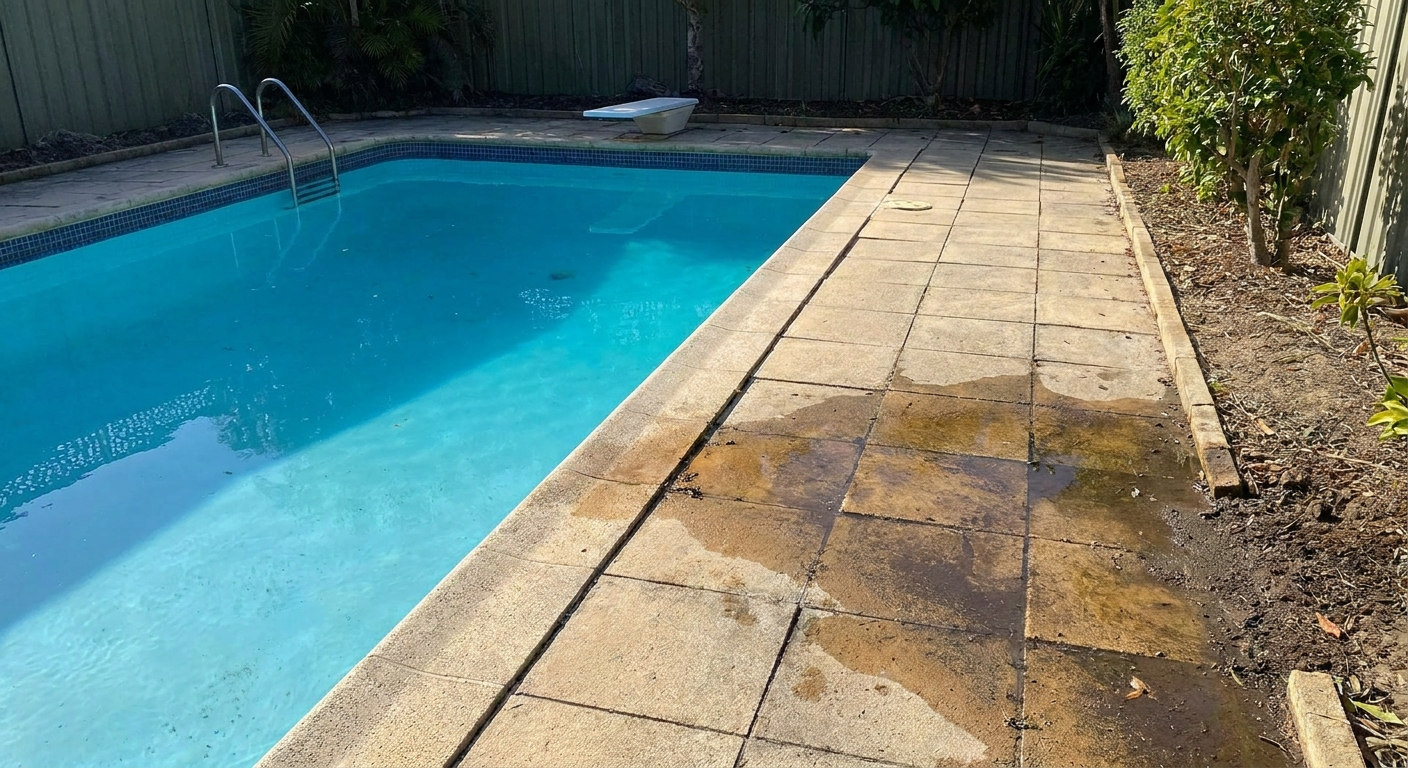
Check the area around your pool deck regularly. Wet spots, soft ground, or algae buildup near the coping aren't random. They're symptoms. And if you're constantly topping off your pool—even when it's not hot or windy—you've got a problem worth investigating.
- Water level drops more than expected, even after accounting for splash-out and evaporation.
- Soggy patches around the deck or coping, especially in areas that should be dry.
- Visible cracks running through the pool shell or surrounding concrete.
- Tiles that are loose, discolored, or missing entirely along the pool's edge.
- Mold or algae growing persistently near the perimeter, fed by constant moisture.
- Air bubbles in your return lines, a sign that water's escaping and pulling air in.
Running the Bucket Test
You don't need fancy equipment to confirm a leak. The bucket test is simple, reliable, and free. Fill a bucket with pool water and set it on a pool step. Make sure the water level inside the bucket matches the pool's level. Mark both with a piece of tape or a grease pencil, then wait 24 hours.
If the pool water drops more than the bucket's, you've got a leak. If they drop at the same rate, it's just evaporation. For edge-specific leaks, inspect the coping, tiles, and expansion joint closely. Look for cracks, gaps, or sealant that's peeling away. A dye test can help pinpoint the exact spot—just turn off the pump, squeeze dye near suspected areas, and watch where it gets pulled in.
Fixing It Before It Gets Expensive
Small leaks can sometimes be handled with putty or sealant. Vinyl liner tears? Patch kits work if the damage is minor. But if you're dealing with structural cracks, failed expansion joints, or widespread tile damage, you're in professional territory. Don't guess and hope—get it assessed.
Pool pros can resurface cracked shells, replace deteriorated joints, and re-tile damaged edges. They'll also tell you if the problem runs deeper—like shifting ground or poor drainage—that needs addressing before the leak comes back. Professional pool repair services can assess structural issues that go beyond simple patches. Cutting corners now just means paying twice later.
Keeping Your Pool Tight Long-Term
Prevention beats repair every time. Inspect your pool's edges at the start and end of every season. Look for cracks, loose tiles, and worn sealant. Keep your deck clean and clear of debris that can trap moisture or cause damage. And maintain proper water chemistry—it protects your materials and extends their lifespan.
If you spot something that looks off, don't wait. A crack that's barely visible today can split wide open after a hard freeze. A gap in the expansion joint that's "not that bad" can let hundreds of gallons escape before you realize what's happening. Catching problems early is cheaper, faster, and a whole lot less stressful.
- Check pool shell, liner, and tiles at the beginning and end of every swim season.
- Inspect expansion joints for cracks, gaps, or deteriorating sealant.
- Keep the deck free of standing water and debris that can cause long-term damage.
- Maintain balanced water chemistry to preserve pool materials and prevent corrosion.
- Address any visible wear or damage immediately, before it turns into a bigger issue.
When to Call In the Experts
If the leak is beyond a quick patch or you're not sure where it's coming from, bring in a professional. They've got tools and experience that make finding and fixing leaks faster and more reliable. Trying to DIY a structural issue usually ends with more damage and a higher bill.
A pro can also tell you whether you're looking at a one-time fix or a recurring problem that needs a different approach. Sometimes the issue isn't the pool itself—it's drainage, soil movement, or aging materials that need a full overhaul. Better to know now than after you've spent money on a temporary patch.
- Professionals use leak detection equipment that pinpoints problems without guesswork.
- They can assess whether the damage is isolated or part of a larger structural issue.
- Proper repairs come with documentation and warranties that protect your investment.
- They'll spot related problems—like drainage issues or ground shifting—that you might miss.
- Getting expert help upfront usually costs less than repeated DIY attempts that don't hold.
Don't Let a Slow Leak Turn Into a Fast Problem
Water loss around the edges isn't something to ignore or put off until next season. It's a sign that something's broken, and broken things don't fix themselves. Whether it's a cracked shell, a torn liner, or a failed joint, the sooner you address it, the less damage you'll deal with down the line.
We've seen pools that could've been patched for a few hundred dollars turn into multi-thousand-dollar repairs because the homeowner waited. Don't be that person. Inspect your residential pool regularly, know the warning signs, and act fast when something looks off. Understanding why a liner is an effective solution can help you make informed decisions about pool maintenance and upgrades. Check out our completed projects to see how we've helped homeowners solve similar pool problems. If you need professional assistance, contact us for expert guidance, or get a quote for your specific pool repair needs. Your pool—and your wallet—will thank you.
Let’s Keep Your Pool Leak-Free
We know how important it is to enjoy your pool without worrying about water loss or hidden damage. If you suspect a leak or just want peace of mind, let’s tackle the problem together before it grows. Give us a call at 843-480-3577 to talk with our team, or get a quote and we’ll help you keep your pool in top shape all season long.
‹ Back
Recent Posts
-
Why PVC Pool Membranes Work Well for ICF Pools
October 13, 2026
-
How Well Do PVC Pool Membranes Hold Up to Daily Use?
September 29, 2026
-
When Should You Repair or Replace a PVC Pool Membrane?
September 15, 2026
-
Is Your Residential Pool Losing Water Around the Edges?
September 1, 2026
-
How Indoor Pools Benefit from PVC Membrane Installations
August 18, 2026

.png)